OUR NEXT ONLINE OPEN DAY OF THE YEAR IS HAPPENING 14 NOVEMBER. DON’T MISS YOUR CHANCE TO LEARN ABOUT YOUR NEW CAREER! • BOOK YOUR TICKET FOR THE HEATHER ROSA TRIBUTE AND MITOCHONDRIA EVENT ON 30 OCTOBER • THE ‘BSC (HONS) NUTRITIONAL THERAPY’ AND ‘CERT HE PERSONALISED DIET AND HEALTH’ APPLICATION FOR THE FEBRUARY 2027 COHORT IS NOW OPEN. APPLY BY 10 NOVEMBER TO TAKE ADVANTAGE OF OUR EARLY-BIRD DISCOUNT • OUR NEW, LEVEL 7, POSTGRADUATE COURSE FOR MEDICAL PROFESSIONALS, ALLIED HEALTHCARE PRACTITIONERS AND CAM PRACTITIONERS IS NOW OPEN FOR APPLICATIONS •
OUR NEXT ONLINE OPEN DAY OF THE YEAR IS HAPPENING 14 NOVEMBER. DON’T MISS YOUR CHANCE TO LEARN ABOUT YOUR NEW CAREER! • BOOK YOUR TICKET FOR THE HEATHER ROSA TRIBUTE AND MITOCHONDRIA EVENT ON 30 OCTOBER • THE ‘BSC (HONS) NUTRITIONAL THERAPY’ AND ‘CERT HE PERSONALISED DIET AND HEALTH’ APPLICATION FOR THE FEBRUARY 2027 COHORT IS NOW OPEN. APPLY BY 10 NOVEMBER TO TAKE ADVANTAGE OF OUR EARLY-BIRD DISCOUNT • OUR NEW, LEVEL 7, POSTGRADUATE COURSE FOR MEDICAL PROFESSIONALS, ALLIED HEALTHCARE PRACTITIONERS AND CAM PRACTITIONERS IS NOW OPEN FOR APPLICATIONS •
Fermenting as an act of resistance with Olia Hercules
caption
Olia Hercules is a cookbook author and chef
image credits
Shutterstock
CATEGORY
Health and wellbeingInternational cuisineInterviewMental healthNutrition
TAGS
foodmental healthnutrition
AUTHOR
Verónica Muñoz Martínez
READ TIME
9 Minutes
PUBLISHED
19 May 2026
SHARE
Key takeaways
Olia Hercules explains how fermentation has long been part of everyday Ukrainian life, rooted in family traditions, flavour and seasonal cooking.
She describes cooking and fermentation as therapeutic practices connected to her experience of ADHD and autism, helping her focus, regulate and reconnect with herself.
Fermented foods are explored not only as nourishment, but as a way of preserving culture, stories and identity across generations.
Through her cookbooks and classes, Hercules hopes to make fermentation feel accessible, communal and joyful for more people.
Ukrainian chef, best-selling cookbook author, fermentation advocate and journalist Olia Hercules talks to Verónica Muñoz Martínez about growing up in Soviet-era Ukraine, the therapeutic power of cooking, neurodiversity, and why preserving food has always meant preserving culture. Olia has appeared in Harper’s Bazaar, BBC, The Guardian and was in The Vogue 25 list as one of the most influential women in 2023.
You grew up in Ukraine. How did fermentation become such a central part of your life?
Food is a really huge part of Ukrainian culture in general, and my family are just incredible cooks. I didn’t grow up learning by my grandmother’s side exactly. Everybody was super busy; they’d shove us off, but I absorbed it by osmosis. Preserving was always just a very normal thing.
In southern Ukraine, I don’t know a family that doesn’t ferment. Everybody does it, especially in the countryside. I sometimes joke that Ukrainians are a nation of preppers, prepping for the end of the world. But it comes from necessity, tradition, and a love of flavour. The cellars in our modest houses are always filled with jars and jars of fermented foods. Before my time, people used to ferment whole watermelons, stuffed aubergines, tomatoes, and apples in pumpkin purée in huge barrels during the winter. In the Soviet Union, in winter, there was nothing in the shops. In the summer, there was nothing either. All these things that are so trendy now, we just grew up with.
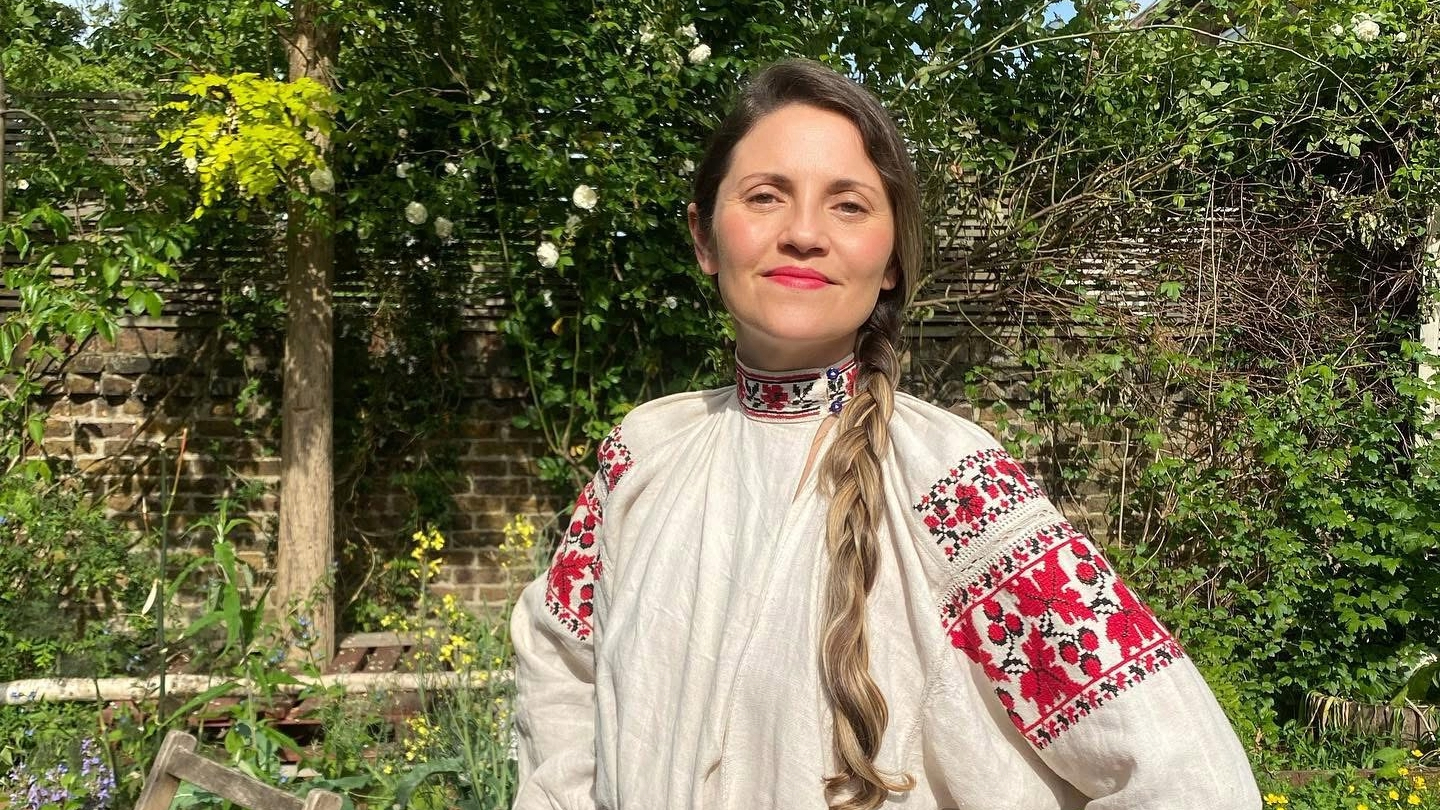
Olia wearing a traditional Ukrainian dress
When did you actually start cooking yourself?
I didn’t start until my early twenties at university. I’d lived in Italy for a year studying Italian, and I saw an Italian family with such a similar energy to mine, that same passionate way of cooking, packets arriving from mums in Sicily. I just reconnected with it. I realised: I miss my family, I miss home. If I start cooking Ukrainian food, I can be connected again.
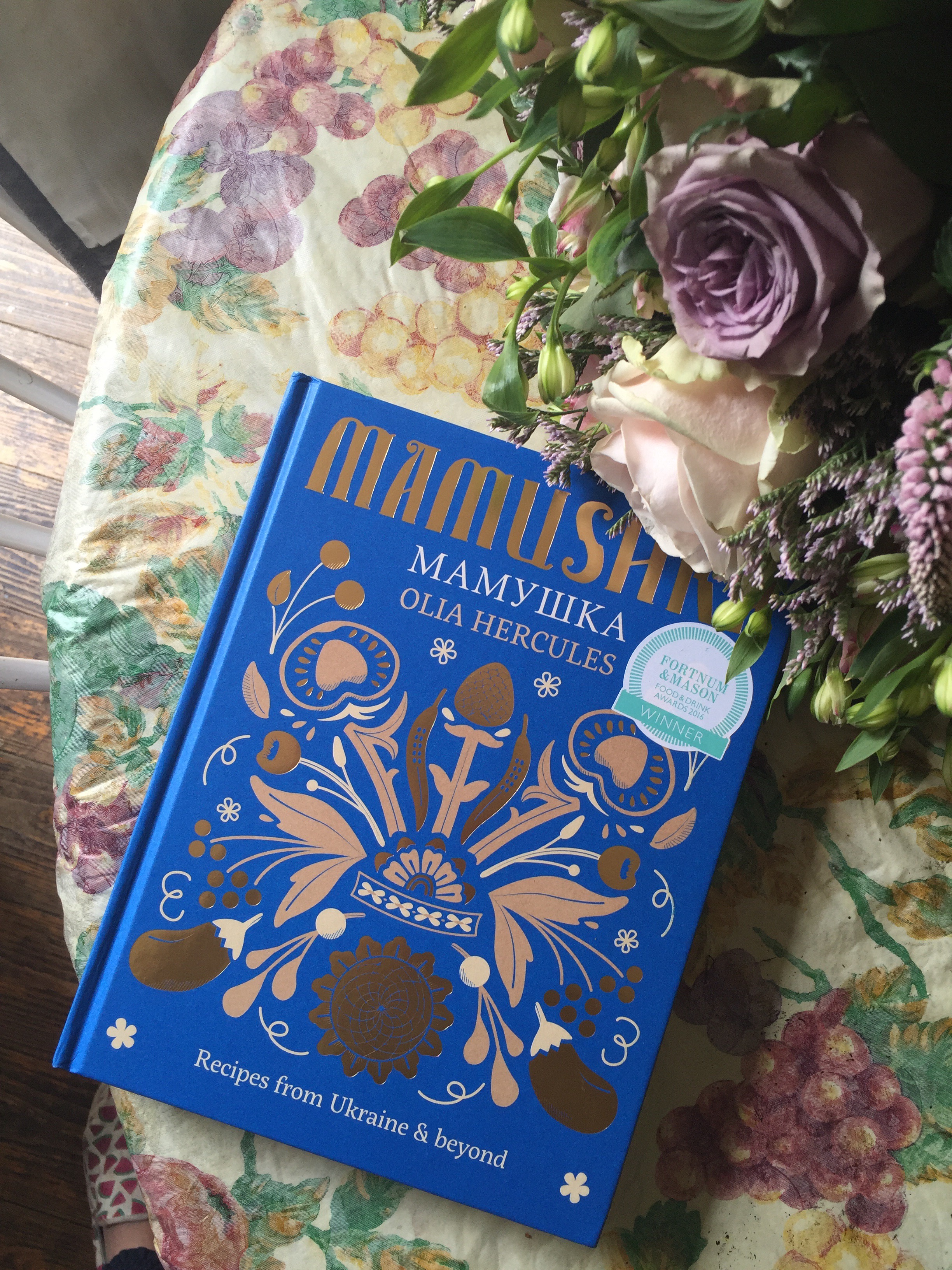
I became obsessed, retrained as a chef at Leith’s School of Food and Wine in London, worked in restaurants including Ottolenghi, and then wrote my first cookbook, Mamushka, in 2015. I was unemployed when an agent spotted my recipes in The Guardian. I remember thinking: Is the world ready for all these fermentation recipes? My publisher said, “It’s your book, so write what you need to write.” Since the book came out in 2016, I can’t tell you the number of times that people have borrowed and credited the fermented tomato recipe in so many books and so many cookbooks in the UK. It was amazing to see that something that my aunties, my mom, and my grandmothers used to make suddenly was, you know, piqued an interest in the people, chefs, cooks, writers in the industry, but also people in general. I’ve written 4 cookbooks now.
Olia’s first cookbook has sold over 150,000 copies worldwide
Did you find cooking therapeutic, beyond just the cultural connection?
One hundred per cent. Even when I worked in restaurants doing 18-hour double shifts, I found deep comfort in it. At Ottolenghi, I did a lot of prep; they’d bring me boxes and boxes of chillies to dice, and I realised I could do that forever. The repetition of the knife, the sounds, just having this one thing to focus on for hours, my mind really rested.
I know now that I’m neurodiverse, which I didn’t know then. I was diagnosed with AUDHD (autism and ADHD) in 2022, at 38, after my younger son Wilfred was assessed and found to have Fragile X syndrome, which causes all sorts of things in boys, including verbal delay. Everything from my childhood suddenly became crystal clear. All of those things that I thought were weird. It’s just like, “oh, okay, I’m just a little bit funky in the brain”, which is not a bad thing at all. The repetition of prep work, the sensory experience of cooking, it all makes so much sense to me. To this day, prepping vegetables for hours feels amazing to me.
It’s exciting to be a part of it [the fermentation world], but also to have my knowledge and everything about it rooted in national and family traditions and to have confidence in that.
And fermentation fits that same pattern?
Absolutely. My AUDHD brain can hyper-focus, and I went completely all-in on fermentation. It became the thread running through all my work. The gut-brain connection also feels very real to me personally. The more I’ve been fermenting and eating ferments, the chirpier I feel. I can’t prove causation, but something is happening.
My son Wilfred, who is six and a half, loves fermented food too. He’s what they call hyposensitive; he needs really strong flavours and input. So, he shoves fermented carrots in as snacks and absolutely loves strong pickles. I wonder if having a healthy microbiome is helping him, because fermentation also makes food more nutritious, and all those elements become more bioavailable. I’m hoping someone will do a proper study one day.
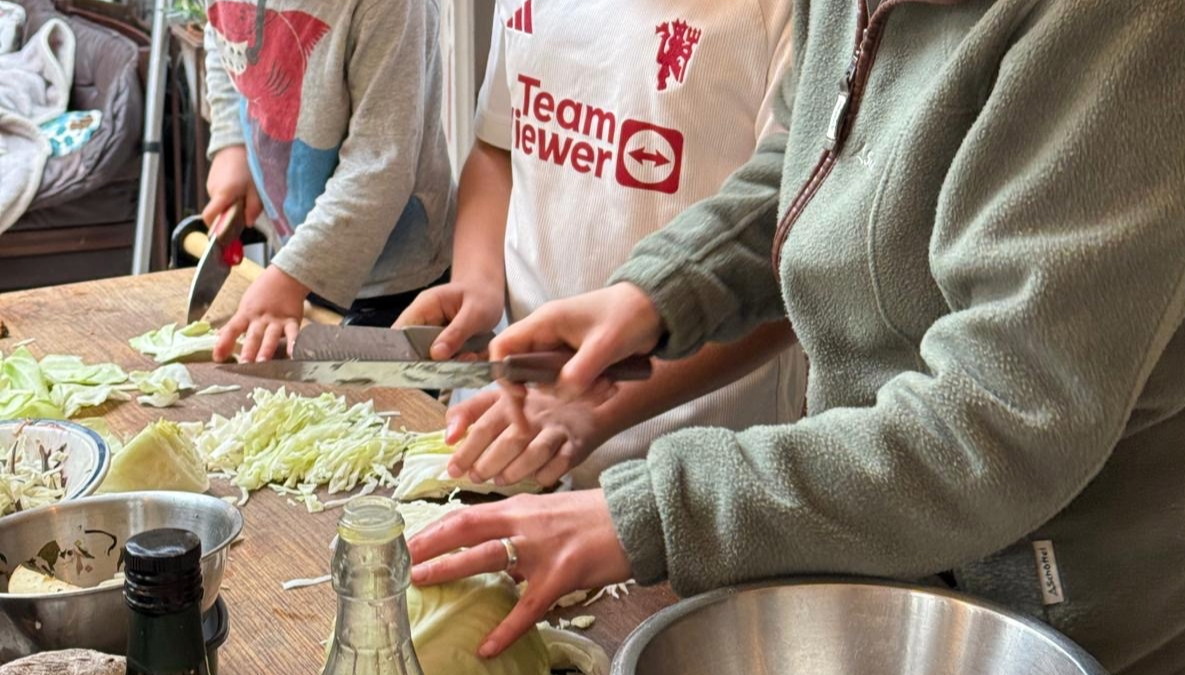
Olia and her sons prepping
Your go-to ferment at home, what is it?
There is always Pelustka on the go. It means “petal” in Ukrainian, which refers to a cabbage leaf, but in this ferment it’s even more apt, because you end up with these big wedges of cabbage fermented in a brine with garlic and a little beetroot. The beetroot dyes the brine a vivid purple, which leaches into the cabbage leaves, and you get these beautiful, mottled things that look like massive rose petals.
I also usually have apples fermenting in pumpkin purée, that’s the traditional Ukrainian way, or sweet potato purée, which I’m testing as a new idea. At the moment I’ve got quite a lot of fermented chilli paste on the go: you just blitz chillies with salt, leave them to ferment, and the result is amazing.
How does your own creative process work when you’re developing recipes?
My starting point is almost always a traditional dish or recipe. My grandmother’s fermented tomatoes, for example. From there, I might adjust it, make it slightly more modern, and add a few flavours. My inspiration comes from old books, old recipes and people’s stories, that’s the driving force.
My husband Joe, who is also a food writer and neurodiverse, works completely differently: he looks at what’s in the veg box, what’s in season, and just invents. For me, it’s always the story of a recipe. Recently, I was testing a kimchi with rhubarb, I’d seen it in a recipe by fermenter Kirsten Shockey, and as I was making it, I thought I’d got some of my Ukrainian fermented pumpkin purée. In it went. That’s how it usually goes.
Your books have a strong anthropological element. Was that deliberate?
Yes, I love that angle. After Mamushka, I used my family connections in the Caucasus to research my second book. My brother and I spent 25 days travelling from house to house in Georgia, Armenia, and Azerbaijan, collecting recipes from real people. I was driven by this desire to record recipes that might one day disappear.
My third book, Summer Kitchens, came from travelling all over Ukraine with my husband. And my fourth, Strong Roots, is a memoir spanning 100 years of my family history, starting in 1919 when my grandmother was born. It’s not a misery memoir; it’s also about beauty, food, and growing. My grandmother Lucy used to say: “If the roots are strong, even if a big storm comes along and blows off all the leaves and the petals and even breaks the stem, if the roots are strong, they will grow again”.
Since the Russian invasion of Ukraine began, has the act of cooking and fermenting taken on a new meaning for you?
Entirely. My hometown is still occupied. My parents’ house was destroyed. When I write Ukrainian recipes now, or teach people how to make this food, it’s an act of resistance. It’s a way to preserve our culture.
The war has also, in a strange way, accelerated a creative energy in Ukraine. There’s a restaurant called Tripicha, “three ovens”, in Kharkiv, which is bombed every day, and the head chef there is making incredible modern Ukrainian food. A writer called Mariana Dushar has a project, Seeds and Roots, travelling Ukraine to record old family recipes before they’re lost. People on the ground are doing extraordinary things.
And there were even moments of dark humour. A woman in Kyiv saw a drone approaching her window, grabbed a jar, threw it and hit the drone. When she was interviewed, she corrected the journalist: “It was fermented tomatoes, actually, which are more explosive.” That story, for me, captures everything. Fermented food is not just sustenance; it’s soft power. Whether we’re writing recipes or aiming jars at drones, there’s something deeply symbolic there.
You now teach fermentation from your home. What do you hope people take away?
Confidence, mainly, confidence that they’re not going to kill anybody. Lacto-fermentation is the safest way to preserve vegetables, and people have been doing it for thousands of years in every country in the world. My classes are split into two: first, we make the ferments, I call them “pickles of the future”, and students join a WhatsApp support group so they can send me photos and ask questions as their jars develop. Then we make dumplings, and we end with a feast: a big platter of all my ferments, the dumplings, organic wine, and conversation.
That communal element matters a great deal to me. In Ukraine, fermenting was always communal; if you had 100 kilos of cabbage to process, you would get the family or even the village together to do it. I want to recreate that feeling here, and eventually I’d love to make the classes cheaper and more accessible for community groups, for teenagers studying home economics, for everyone.
What’s on the horizon?
More cookbooks, and perhaps a novel or another memoir. More teaching, including online classes through my Patreon community. And more funding to make these classes more affordable. One day, when the war is over, I’d love to make a TV show, going back to Ukraine to see how food and fermentation have changed, how creativity has spiked, how, in some cases, it literally helped people survive. I really hope that happens.
Olia Hercules’ memoir Strong Roots is published by Bloomsbury. Her online fermentation and cookery classes are available through her Patreon community.
Good to know
About Olia Hercules
Olia Hercules is a Ukrainian-born, London-based chef, food writer and cookbook author whose work explores Eastern European food traditions, memory and identity through recipes and storytelling. She has written several award-winning cookbooks, including Mamushka, and is known for bringing Ukrainian and regional fermentation and home cooking to a global audience.