OUR NEXT IN-PERSON OPEN EVENT IS HAPPENING ON 1 AUG 2026. DON’T MISS YOUR CHANCE TO LEARN ABOUT YOUR NEW CAREER! • THE BSC (HONS) NUTRITIONAL THERAPY APPLICATION DEADLINE IS APPROACHING FAST – APPLY TODAY! • ION STUDY LIFTS THE LID ON PLANT-BASED ALTERNATIVES •
OUR NEXT IN-PERSON OPEN EVENT IS HAPPENING ON 1 AUG 2026. DON’T MISS YOUR CHANCE TO LEARN ABOUT YOUR NEW CAREER! • THE BSC (HONS) NUTRITIONAL THERAPY APPLICATION DEADLINE IS APPROACHING FAST – APPLY TODAY! • ION STUDY LIFTS THE LID ON PLANT-BASED ALTERNATIVES •
David Sogan spent 25 years solving problems in some of the world’s toughest places. Now, as an ION Graduate Diploma student, he’s tackling one closer to home – teaching young people to see through the food industry’s tricks, one school at a time.
David is the kind of person who, when he notices a problem, does something about it. It’s a trait forged over a long career in international development – working across Africa, Afghanistan, Rwanda, South Africa and beyond on everything from education to health infrastructure. “The joy of that for me was problem solving,” he says. “You’d come into a place and find a way of making life better for people.”
These days, the problem he’s focused on is closer to home. David, 64, is in his final year of ION’s Graduate Diploma in Nutritional Therapy – and in parallel, he’s co-leading the Real Food Rebellion, a nutrition education programme now operating in 64 secondary schools across the UK.
A personal wake-up call
Like many people who end up in nutrition, David’s journey started with his own health. A routine private blood test revealed his HbA1c was borderline pre-diabetic – a surprise for someone who exercised regularly and considered himself fit and well. “I thought, how can that be? I eat a pretty good diet,” he recalls.
He started researching, tried a lower-carbohydrate diet, and within a few months his blood sugar had improved. He also lost around six kilos without trying and noticed other changes he hadn’t expected: bloating he’d long written off as normal disappeared, his energy stabilised, and he slept better. “It’s only when those things stop that you realise they weren’t normal in the first place,” he says.
That experience drew him to Public Health Collaboration, where he trained as a health coach and spent several years working with people using diet and lifestyle to put type 2 diabetes into remission. “I’d seen lives massively changed just from nutrition. I was completely sold,” he says. “And I thought, more people need to know about this.”
Meeting ION’s Dean Heather Rosa at an event convinced him to go deeper. “As a health coach, you’re teaching a particular protocol. I wanted to understand how the body systems actually work, how they interact with nutrition, at a much deeper level.” He enrolled in the Graduate Diploma, and hasn’t looked back. “If I’d known how much study was involved, I probably would never have started. But I’m so pleased I did – I’ve found capabilities in myself I didn’t know I had.”
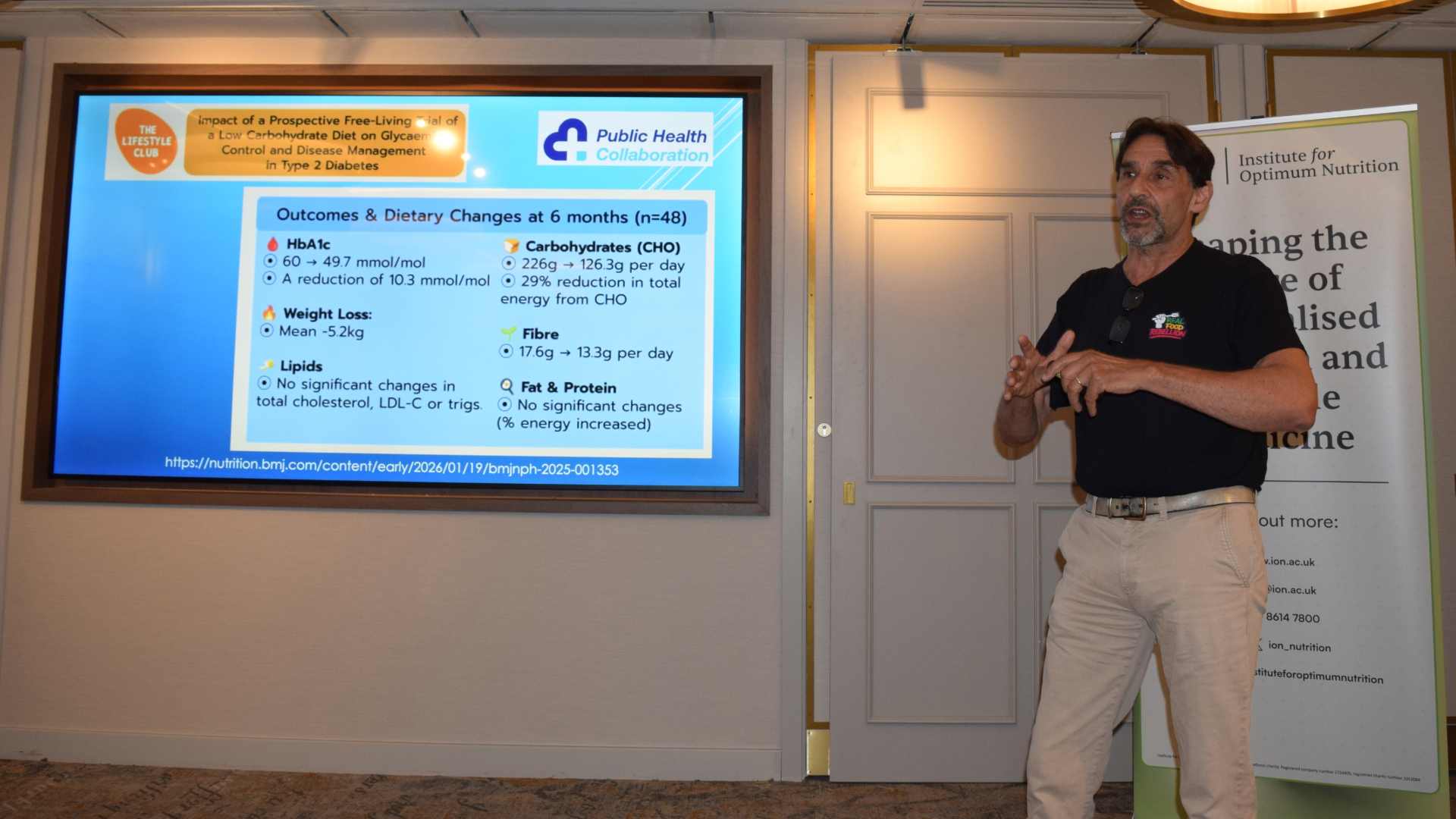
David Sogan speaking at ION’s Open Day Event
Starting a rebellion
The Real Food Rebellion began about three years ago, born out of a simple frustration: children in the UK are growing up surrounded by ultra-processed food, with almost no education to help them make sense of it. “Some kids don’t even know what a potato looks like,” David says. “They’ve only ever seen fries or mashed potatoes.”
The original programme was ambitious – ten hour-long lessons going deep into the science of food and nutrition. The pilot, at a single school, did not go well. “They hated it. Teachers were pushing back saying it was radical, that you can’t tell children this. We had to go back to the drawing board.”
The revised version is six 45-minute lessons, designed for 14-year-olds – interactive, engaging, and built around a few clear messages: eat more real food, eat less ultra-processed food, cut back on sugar, and learn to spot how food companies try to manipulate your choices. “The feeling of the rebellion is: you’re being conned. You’re being fooled into buying all this rubbish, and it’s harming your health. Just say it’s not good enough.”
The second pilot, in five schools, was a different story. Feedback from students was enthusiastic – they felt they’d learned something genuinely important, and said they were going to make changes. “We’re not expecting them to give up everything,” David explains. “Just, you know, if you have an energy drink every day, try saving it for the weekend. Start somewhere.”
For the programme’s first full year, the target was 40 schools. They’ve signed up 64 so far, with funding from the NWF helping to professionalise the materials. “It’s still the tip of the iceberg,” David acknowledges, “but these things grow over time. The more visibility we get, the more schools will say, actually, our kids need this.”
“We live in a very dystopian environment when it comes to food marketing. We have to have things to counteract that – to say, hang on, those foods aren’t healthy.”
The bigger picture
David is clear-eyed about the scale of the challenge. The UK has one of the highest childhood obesity rates in Europe, and he sees the causes as cultural as much as dietary. “We’ve always had a fairly weak food culture compared to southern Europe,” he says, “but now we’ve lost it completely. Many parents and even grandparents don’t know how to cook. They only know how to reheat.”
He’s scathing about what he calls the government’s ‘ridiculously small’ interventions – pointing out that much-publicised advertising restrictions on foods high in sugar and fat work out, mathematically, to just over one calorie cut per child per day. “It’s so weak as to be meaningless,” he says. And legislation, he notes, always gets watered down by food industry lobbying.
Alongside The Real Food Rebellion, David is a director of Embrace Nutrition, a workplace wellness programme currently piloting with three companies, offering six-session courses focused on metabolic health, complete with blood tests and two weeks of continuous glucose monitoring so participants can see in real time how different foods affect their blood sugar. He’s also a regular speaker at Public Health Collaboration events, and is thinking carefully about his clinical focus when he qualifies: metabolic dysfunction in older adults, and – following a personal experience with one of his sons – chronic fatigue syndrome.
“Chronic fatigue can take years of productive life away from a young person,” he says. “And right now the message is: we don’t know the cause, we can’t do much. But it is a metabolic disease. It is absolutely actionable with the right nutrition and support.”
Why nutrition needs more men
At an ION industry day he attended recently, David counted the men in the room. Out of around 200 people, there were three. It’s a dynamic he finds fascinating and frustrating in equal measure. Men, he argues, tend to approach their health through the lens of performance – protein shakes, energy drinks, gains – rather than through genuine enquiry into what’s working and what isn’t. They normalise symptoms they shouldn’t and tune out warning signs until something serious forces them to pay attention.
“Men like a clear solution,” he says. “A bit more black and white. Nutrition is tied up with emotion and individual experience, and I think men are less comfortable with that. But getting the framing right – focusing on performance, on what they’ll be able to do better – I think there’s an opportunity there.” As one of very few male nutritional therapists in training, he’s optimistic about the role he might play.
At 64, having made more career pivots than most people manage in a lifetime, David says he’s never felt more energetic, more focused, or more genuinely well. “I probably feel healthier now than I did at 44,” he proudly says. “That’s what’s possible. And I’d like to help a few more people find that out for themselves.”
END OF ARTICLE
Our graduate studied...
Graduate Diploma Integrative Functional Nutrition
Our GradDip Integrative Functional Nutrition offers a fast track qualification in integrative functional nutrition to qualified medical and healthcare professionals.