OUR NEXT ONLINE OPEN DAY OF THE YEAR IS HAPPENING 14 NOVEMBER. DON’T MISS YOUR CHANCE TO LEARN ABOUT YOUR NEW CAREER! • THE ‘BSC (HONS) NUTRITIONAL THERAPY’ AND ‘CERT HE PERSONALISED DIET AND HEALTH’ APPLICATION FOR THE FEBRUARY 2027 COHORT IS NOW OPEN. APPLY BY 10 DECEMBER TO TAKE ADVANTAGE OF OUR EARLY-BIRD DISCOUNT • OUR NEW, LEVEL 7, POSTGRADUATE COURSE FOR MEDICAL PROFESSIONALS, ALLIED HEALTHCARE PRACTITIONERS AND CAM PRACTITIONERS IS NOW OPEN FOR APPLICATIONS •
OUR NEXT ONLINE OPEN DAY OF THE YEAR IS HAPPENING 14 NOVEMBER. DON’T MISS YOUR CHANCE TO LEARN ABOUT YOUR NEW CAREER! • THE ‘BSC (HONS) NUTRITIONAL THERAPY’ AND ‘CERT HE PERSONALISED DIET AND HEALTH’ APPLICATION FOR THE FEBRUARY 2027 COHORT IS NOW OPEN. APPLY BY 10 DECEMBER TO TAKE ADVANTAGE OF OUR EARLY-BIRD DISCOUNT • OUR NEW, LEVEL 7, POSTGRADUATE COURSE FOR MEDICAL PROFESSIONALS, ALLIED HEALTHCARE PRACTITIONERS AND CAM PRACTITIONERS IS NOW OPEN FOR APPLICATIONS •
Mind the gap: realistic steps to improve men’s health
caption
This Movember, start the conversation about men’s health earlier, for the next generation too
image credits
Shutterstock
CATEGORY
Health and wellbeingNutritional therapy
TAGS
dietmen's healthmental healthmovember
AUTHOR
Veronica Munoz Martinez
READ TIME
14 Minutes
PUBLISHED
18 November 2026
SHARE
Key takeaways
Men wait too long to seek help. UK men see their GP 32% less often than women, and often only come in once symptoms become hard to live with or a chronic illness develops.
Health starts in the community. Debt, housing, insecure work and limited access to affordable fresh food all shape men’s health. Support works best when it fits men’s lives, like a darts night or a woodworking group.
Small changes add up. Cutting back on alcohol, getting moving, setting regular sleep times and eating more fruit and vegetables can build on one another.
It’s never too late to start. Eat more vegetables, fibre and oily fish, don’t make it all about protein, and if you’re aged between 40 and 74 in England, ask about a free NHS Health Check.
Every November, men’s health charity Movember asks men to “grow a Mo, save a Bro”. The month-long campaign raises awareness and funds for mental health and suicide prevention, and for prostate and testicular cancer. To mark it, we spoke to four men working to close the gap in men’s health. Verónica Muñoz Martínez writes
The only memories I have of my grandfathers are borrowed ones. They come from my grandmothers, from my parents, from the very few old photographs I have of them. Both died when I was just one year old. I’m told they loved pushing my pram around our small town, proudly showing off their granddaughter to every passerby.
They never got to see who that baby became. One had lived with stomach pain for a long time before finally undergoing surgery, but he didn’t survive. The other spent years with half of his body paralysed.
Their story is not unusual. In England, men still die almost four years earlier than women: provisional data for 2025 puts life expectancy at 80 for men and 83.8 for women. And the gap between men is widening. A man in England’s most deprived areas can now expect to live around 10 years less than a man in the wealthiest, and to spend almost 20 fewer years in good health.
This Movember, I wanted to understand why. So I spoke to four men approaching the problem from very different angles: a GP and researcher who measured how rarely men see their doctor; the executive director of a national trust funding grassroots programmes that give men space to talk; a nutritional therapist who has spent 28 years trying to get men through his practice door; and a 24-year-old who swapped nights out for 100 sober days, then ran from Norway to London.
“Men think the problem will go away”
Booking an appointment early, before something breaks, can make all the difference. (Shutterstock image)
Irwin Nazareth, an academic GP, had noticed it for years in his own surgery: men simply came in less. So he and his colleagues measured it. Their 2013 study of almost 3.8 million UK patients found that men consulted their GP 32% less often than women.
“It didn’t surprise me,” he says. “I had observed this as a clinician. But nobody had documented it in real data.”
The gap was widest between the ages of 16 and 60, and it remained even after the team accounted for consultations relating to contraception, pregnancy and other reproductive health needs. It was also greater in more deprived areas. Below 16 and above 60, men and women visited at similar rates.
“Once there is a chronic disease, they come more often,” Irwin explains. Prescriptions need reviewing, so men are, in his words, “forced to consult”.
Why do they stay away until then? “Men tend to think the problems will go away, so they don’t come until the symptoms are quite intolerable,” he says. “Sometimes they’re afraid of a diagnosis, so they hide their heads in the sand. And there is a superhuman attitude some men have: I’m strong, nothing will happen to me.”
Women, by contrast, are drawn into the health system from puberty. Periods, contraception and pregnancy all bring routine checks of blood pressure, weight and hormones. “Men don’t have all that from 16 to 60,” Irwin says. “They escape the system until they get a chronic illness, often after 60, or an acute one, like cancer.”
That imbalance shows up in screening too. Women are routinely invited for breast and cervical checks. Bowel screening covers everyone. But there is no national programme for prostate cancer, the most common cancer in men. In June 2026, after a long public campaign backed by David Cameron and Sir Chris Hoy, the government confirmed that only a few thousand men at the highest genetic risk would be offered regular tests. Any man can still ask his GP for a PSA blood test if he has concerns.
The same reluctance applies to mental health.
Men seek help much later because they try to deal with it on their own. It’s a sign of being strong and tough. It’s part and parcel of the same phenomenon.
He sees signs of change in younger generations, but says men over 40 remain the least likely to seek help.
There are also important differences in physical health. Oestrogen offers women some protection against cardiovascular disease before menopause, whereas men tend to face a higher risk at younger ages. “Men also tend to have worse diets,” he adds, “so their cardiovascular problems can be further exacerbated by lifestyle.”
Darts, woodwork and the building blocks of health
Connection matters: check in on your dad, your brother, your mate… (Shutterstock image)
If Irwin’s research shows that men stay away from the GP surgery, John Hume wants to know what is keeping them there. He is Chief Executive of People’s Health Trust, a national charity working with communities “to stop people dying too young”.
“For 100 years we had rising life expectancy and rising healthy life expectancy,” he says. “In the last decade, that’s gone backwards.” He points to England’s first ever Men’s Health Strategy, published in November 2025: men born in the most disadvantaged communities die almost 11 years younger than those in the least deprived.
So, someone in a poorer community might start developing health problems at 51. In a wealthy neighbourhood, it’s 70. That can’t be right.
This year, the People’s Health Trust joined the Department of Health and Social Care and Movember in launching the £6.3 million Men’s Health Community Fund. The partnership brings together organisations with different areas of focus: Movember focuses on younger men; People’s Health Trust on older men who are struggling through different life transitions. When the Trust asked men what was affecting them, 96% said their mental health. The causes were debt, housing conditions, rent, insecure work, not enough time with family, relationship breakdown…
That, John argues, is why telling men to “just talk” falls short. “A counsellor can’t pay your debt. If you’ve got a really difficult housing issue, you need specific advice to get out of it.” He thinks that even when men do need psychological support, the format often fails them. “They’d rather be walking and talking, or making things and talking. Services aren’t designed by men, for men.”
He has seen what works. On an estate in Gateshead, attempts to get men into a support group went nowhere. Then someone suggested a dartboard. “From darts came discussions, and discussions became their issues: unemployment, how much they were struggling, loneliness. But if we’d said, come to a men’s loneliness group, they’d have said no way.” In Wales, a woodworking group repairing fences on an estate turned into something else entirely. “While they were making things, they were taking care of each other. Asking, you don’t seem so well. Have you missed your medication?”
Men do speak if they’ve got the right environment. They see it as a strength, not a weakness.
The Men’s Health Community Fund targets the life moments where men are most exposed: becoming a father, losing a job, retiring. “Their identities are bound up in work,” John says. “Yet support at those stages is really patchy.” The Trust is also working with the construction sector, where, he says, two men take their own lives every day in the UK.
Food sits at the heart of it, too. In the communities he has worked in for years, “you’ll find betting shops and pharmacies but no fresh, affordable food”, while ultra-processed food is cheap and everywhere. Parents working two jobs grab whatever is quickest. “A lot of nutrition advice just isn’t easy for people on very low incomes who are also time poor.”
He describes chronic stress as something that “gets under the skin”, turning into anxiety and depression, then into hypertension, heart disease and diabetes. “Those things end up on the death certificate. In fact, they died as a result of poverty.”
If you plant a tree in soil that lacks nutrition and sunlight, it grows weaker, with shallow roots. Tree surgeons can prune it, but it will never be as strong as the one two metres away. What I want is nutritious soil for everyone.
John is optimistic about the future. With a national strategy, government backing and a push towards neighbourhood health, “there’s an opportunity to change the narrative for men. It is okay to talk. But those services should be the kinds of services you actually want to go to.”
Luke’s story: 100 days sober, 86 marathons
Luke Bellingham’s turning point came in January of his second year at university. After a first year of freshers’ nights out, he could feel the same cycle beginning again. “I remember thinking, I can’t keep doing this,” he says. “You end up down roads you don’t want to be on, and it’s a recurring thing.”
A podcast clip stuck with him: “If you keep doing the same thing, you’ll keep getting the same results, so change one thing and let it snowball.”
Luke changed two. He stopped drinking for 100 days, and he started running. “I couldn’t do a 5K straight off the bat. I was quite unfit.”
Sobriety came with an unexpected lesson about British drinking culture. “Someone once said alcohol is the only drug where, if you don’t take it, people ask if you’re okay,” he says. “I’d turn up to parties and say I’m not drinking, and they’d ask, is everything all right?” Stepping back, he noticed it everywhere: a pub on every corner, beer adverts across the Tube.
The changes fed each other. No hangovers meant more mornings free to run. More running meant he started eating properly again. “I was eating loads of yoghurt and fruit, which I hadn’t eaten in ages. I’d forgotten how nice it was.” He began going to bed at set times too. “It’s all little steps that build a better outcome.”
The running took over. His social media filled with Russ Cook, the “Hardest Geezer”, who had run the length of Africa. “I thought, I can barely run 5K and this man’s doing back-to-back marathons. If he can do it, why can’t I?” Six months later, Luke ran the Royal Parks Half Marathon. Then came a 12-hour ultra in Lichfield, where he covered 73km, further than he had ever run.
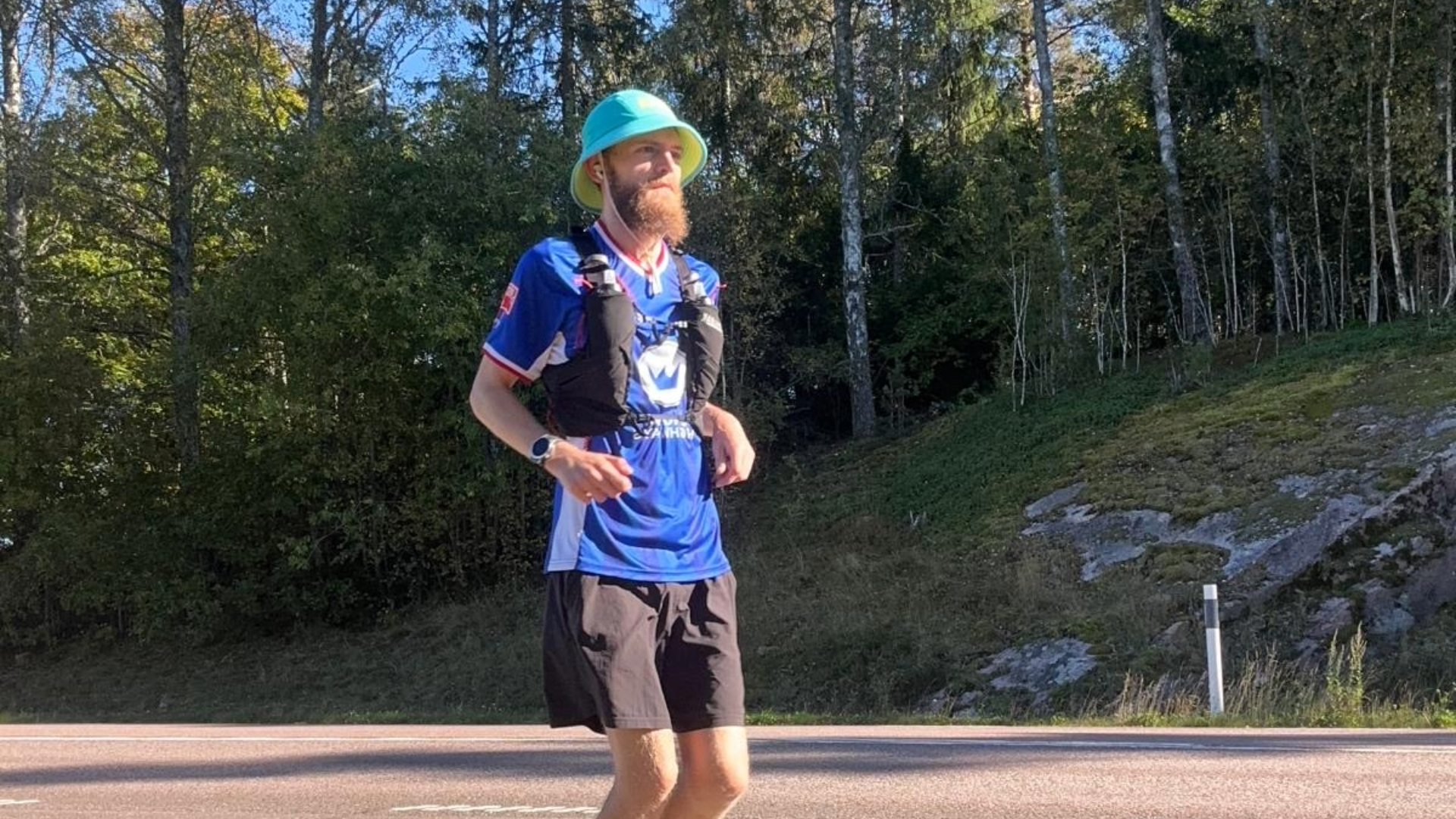
Luke started running to improve his mental health (Luke Bellingham)
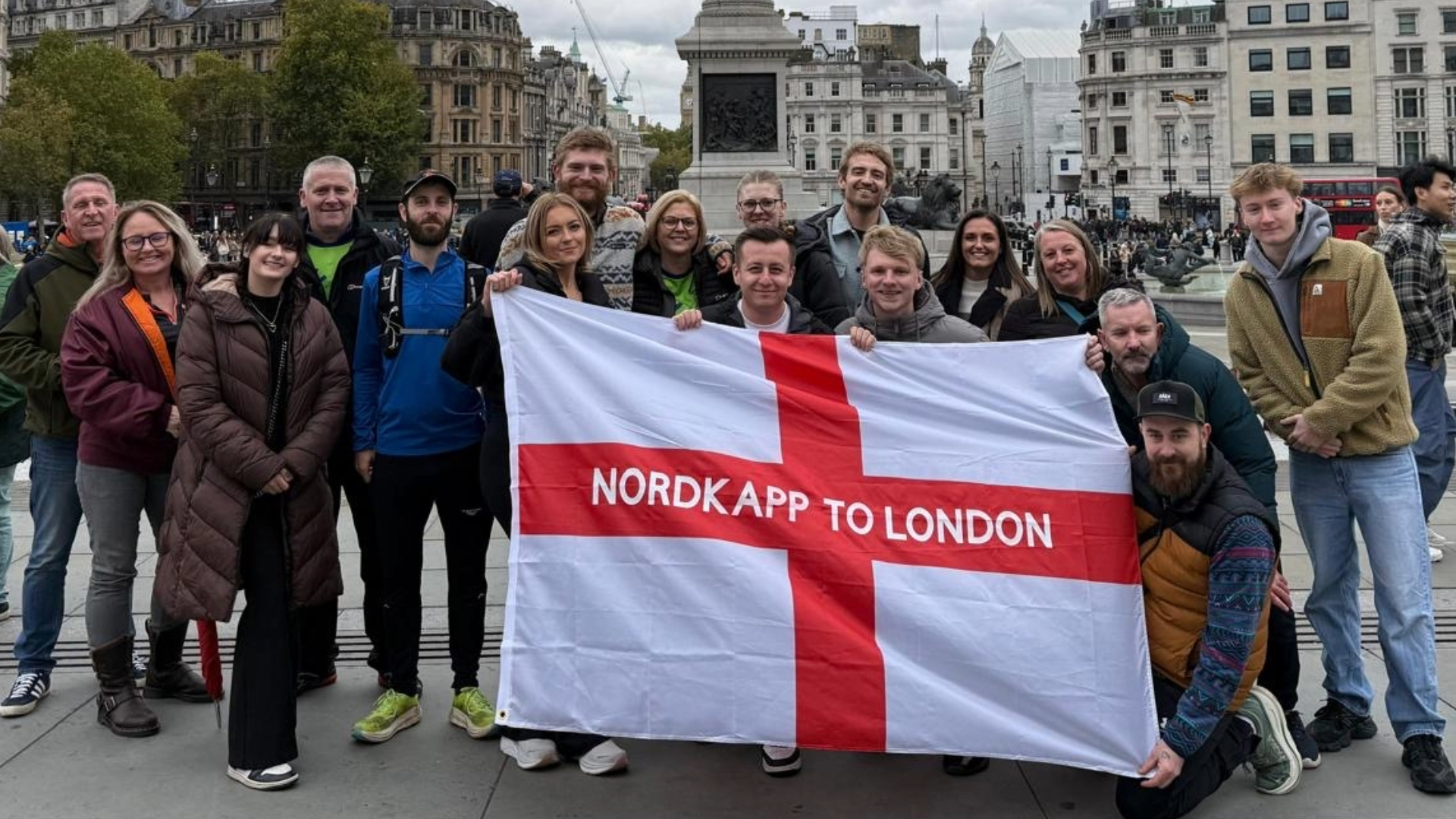
In August 2025, he set off from Nordkapp, the northern tip of Norway, under a sun that barely set. Seventy-one days and 86 marathons later, he crossed the finish line in Trafalgar Square, raising money for Kids Village, a local charity building a holiday village for seriously ill children and their families.
Luke and his family in Trafalgar Square (Luke Bellingham)
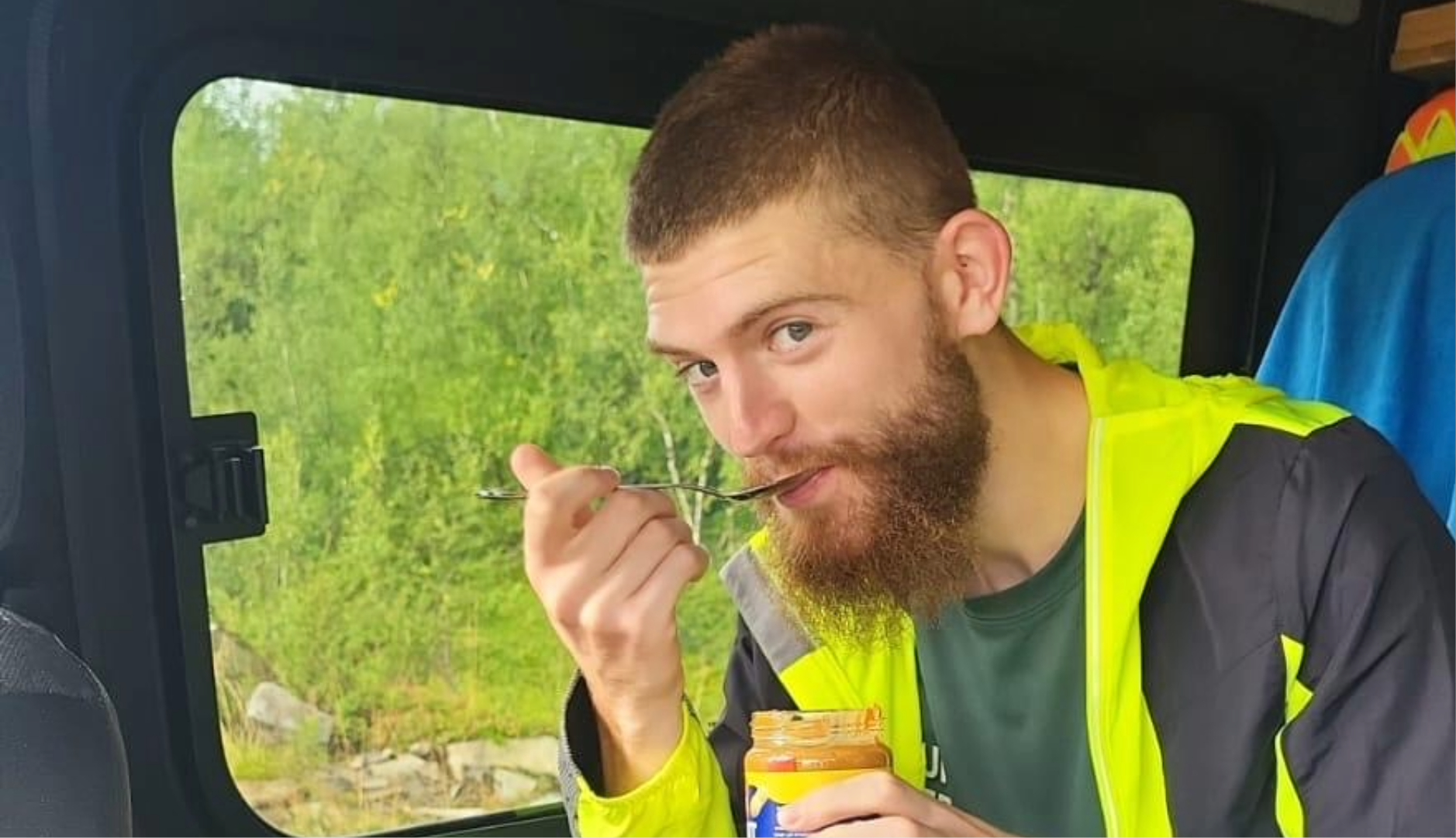
He averaged around 54km a day and burned roughly 5,000 calories, double what an average man needs. Fuelling was relentless: cereal and toast with honey and peanut butter at breakfast, snacks every 20km, pasta and bacon sandwiches at lunch, a carb-heavy dinner. Even so, he dropped from 75kg to 63kg. “There wasn’t anything on me at all.” It is not a plan anyone should copy, but it shows how hard the body works, and how much it depends on food for fuel.
Luke’s run fuel: a peanut butter jar (Luke Bellingham)
Asked about mental health, Luke is honest that he still leans towards the traditional instinct: “I’ll solve this on my own.” But running gave him routine and something steadier than a night out.
I read once that getting drunk is borrowing happiness from tomorrow. With running, you don’t want to do it to begin with, but you’re happy afterwards. The long-term effects are a lot better.
He still enjoys a pint, but those 100 days taught him balance.
His advice to other young men is simple.
Set yourself a goal, however small. Eating properly, the gym, running around the block. That discipline is only going to do good things. Keep friends who aren’t in your bubble. They ground you and remind you to appreciate what you’ve done.
A nutritional therapist tip: It’s never too late
Burgers, chips and beer are still seen as “manly” food, but men’s diets play a big part in their heart health (Shutterstock image)
Nutritional therapist Ian Marber has been in practice for 28 years, and his clients are still mostly women. “A typical scenario is that I see a woman, and she says she wants her husband to see me,” he says. “He may or may not book in.”
When men do come, it is usually because something has already gone wrong, often a raised cholesterol result. “Men need a warning sign to make changes,” he says. They want one appointment and clear instructions, rooted in science. “They’re not interested in nuance. They’re very good at following instructions, but not very good at following up.”
Some of his clients from 20 years ago still eat exactly as he advised.
He has also noticed a shift online. Men ask him far more questions on social media than they used to, but many are following influencers whose bodies are their job. “For a lot of men, looking muscular means they are healthy.”
Food itself is gendered too: a 2012 University of Huddersfield study found that men eating salads, fruit and vegetables were judged as more feminine than men eating burgers, chips and beer.
His advice for men who want to start:
Don’t make it all about protein. “The most common mistake is focusing too much on protein and ignoring complex carbohydrates and essential fats.” Protein alone won’t protect your muscles as you age; pair it with resistance training.
Eat more vegetables. “It sounds really basic, but if you ask a man where his fibre is, he’ll point to his pasta or rice.” Cruciferous vegetables such as broccoli, cabbage and cauliflower, plus brightly coloured fruit and veg rich in polyphenols, matter for prostate health.
Aim for 30g of fibre a day, but count progress. “If you say 30g is the aim and 22g and above is good, men are very good at incorporating things and keeping them there.” Oats are an easy start.
Look after your heart. Eat oily fish, drink less, don’t smoke and manage your weight. “Read about atherosclerosis, cholesterol and blood pressure. Understand how your heart works.”
Skip the testosterone supplements. “There’s no supplement that can really help, despite wild claims.” The biggest influences are sleep and excess weight.
Age doesn’t change the rules, he says; it just raises the stakes. “You can get away with things in your 20s and 30s. As we get older, good nutrition becomes more important.” And what does he tell every male client? “It’s never too late. Start today.”
Don’t wait for the warning sign
Speaking to these four men, one thread kept coming back. Men are not careless about their health. They are often stretched, under pressure, told to be strong, and offered support that doesn’t fit their lives. So they wait until something breaks.
The fixes are rarely dramatic. A dartboard on an estate. A run before work. A bowl of oats, a portion of oily fish, a few more vegetables on the plate. A GP appointment booked before the symptoms become unbearable. If you’re aged 40 to 74 in England, you can ask about a free NHS Health Check. If something about your prostate worries you, you can ask your GP for a PSA test.
I will never know whether my grandfathers’ stories could have ended differently. But I hope the men reading this, and the women who love them, start that conversation earlier. Check in on your dad, your brother, your mate. And if you’re a man reading this: it’s never too late. Start today.